
You are drowning in content tasks. Planning, writing, editing, posting. Hours vanish. Meanwhile, the actual work that grows your business gets shoved to tomorrow. And tomorrow never comes.
Here is the part most people miss. The problem is not that you need more content. Rather, it is that you are creating content the wrong way. There is a system that turns meetings you are already having into a steady stream of posts, emails, and videos. Almost zero extra effort. In this article, I will walk you through the 6 steps to make that happen.
- Essentially, manual content creation costs you 5 to 10 hours per week that should go toward revenue-generating work.
- Your meetings and calls already contain everything you need. Simply record them, transcribe them, and then let a system do the rest.
- The best content puts your customer at the center of the story, not your brand. Automation should amplify their narrative.
- 1 recorded conversation can produce 5 to 8 pieces of content across channels without extra effort.
- Just start with 1 step. Do not try to build the whole machine on day 1.
Why Manual Content Is Bleeding Your Calendar Dry

Let me be direct. If you are writing every post, every email, every caption from scratch, then you are burning the most expensive resource you have. Your time.
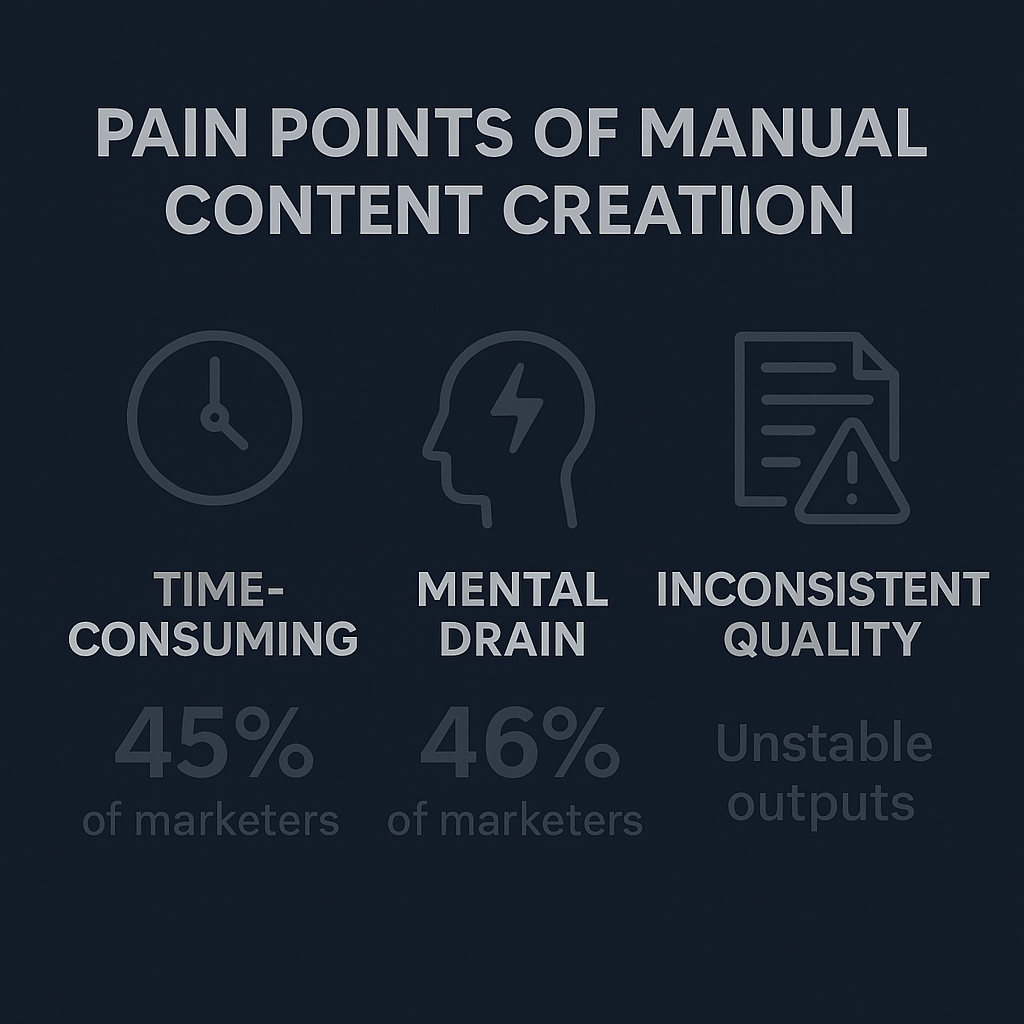
Manual content creation hits you in 3 places at once:
- Time drain: A single blog post takes 3 to 4 hours when you factor in research, writing, and editing. According to Orbit Media’s annual blogging survey, the average blog post now takes 4 hours and 10 minutes to produce. In other words, that is half a workday gone.
- Mental fatigue: The pressure to constantly generate fresh ideas leads to burnout. You start avoiding the task altogether. Eventually, weeks go by. Nothing gets published.
- Uneven quality: Some weeks you are sharp. But other weeks you are running on fumes. The output reflects that, and accordingly your audience notices the gaps.
However, here is the thing that changed my approach entirely. In Building a StoryBrand, Donald Miller makes a point that stuck with me: the customer is the hero. Not you. Not your brand. The customer. So if your content process is built around you sitting down to be clever, then you have already missed the point. Instead, the system should be built around capturing what your customers need to hear, then delivering it consistently.
How to Stop Thinking Like a Creator and Start Thinking Like a System
Most business owners treat content as a creative act. Sit down. Stare at a blank page. Try to be interesting. Obviously, that approach does not work when you also have payroll to run, clients to serve, and a team to lead.
Instead, treat content as an operational output. In other words, something your business produces automatically as a byproduct of work you are already doing. This reframe unlocks 2 things:
- Your conversations are the raw material: Every client call, team meeting, and strategy session contains insights your audience needs. You are already generating the input. Yet you are just not capturing it.
- 1 input becomes many outputs: For example, a single 30-minute call can produce a blog post, 3 social posts, an email, and a short video script. No extra thinking required.
This is the Miller principle in action. When you stop trying to perform and start capturing what your customers actually care about, the content gets better and easier to produce. As a result, you spend less time creating and more time serving.
Your 6-Step Content Automation System
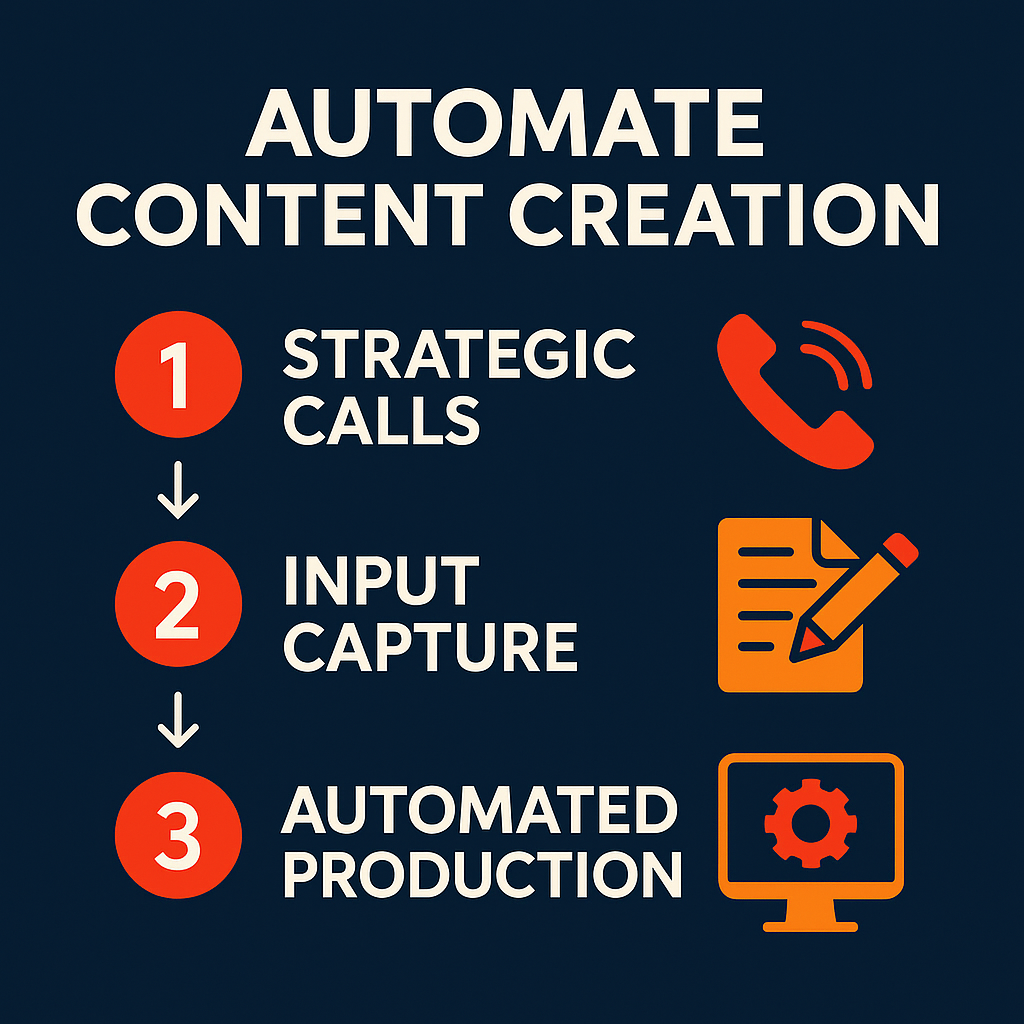
Here is the exact system. 6 steps. Specifically, each one builds on the last.
- Record every call: Zoom, Google Meet, Loom. It does not matter which tool. What matters is that you press record. Similarly, every client call and team meeting becomes raw content material. Tools like Otter.ai or Zoom’s built-in transcription make this effortless.
- Transcribe automatically: Replace manual note-taking with AI transcription. In other words, the ideas get captured whether you remember to write them down or not.
- Extract the customer story: This is where Miller’s StoryBrand framework matters most. Specifically, scan each transcript for the customer’s problem, their desired outcome, and the obstacle in between. That is your content angle. As a result, it positions the reader as the hero every time.
- Build content from the transcript: Use AI writing tools to turn transcribed insights into drafts. Blog posts, email sequences, video outlines. Therefore, your direct involvement drops to review and approval.
- Multiply across channels: 1 transcript becomes 5 to 8 pieces. A blog post. A LinkedIn post. An Instagram caption. Also an email and a short video script. Each formatted for its platform. Consequently, your reach grows without multiplying your effort.
- Cut the duplicate steps: Finally, audit your process for anything you are doing twice. Manual copy-paste between tools. Formatting the same content 3 different ways. Eliminate it. Then your energy goes toward growing the business, not feeding the content machine.
Research from the Content Marketing Institute shows that businesses with a documented content process are 3x more likely to report success than those winging it. Furthermore, the businesses that automate parts of that process report even higher consistency and output volume.
What Changes When You Flip the Switch
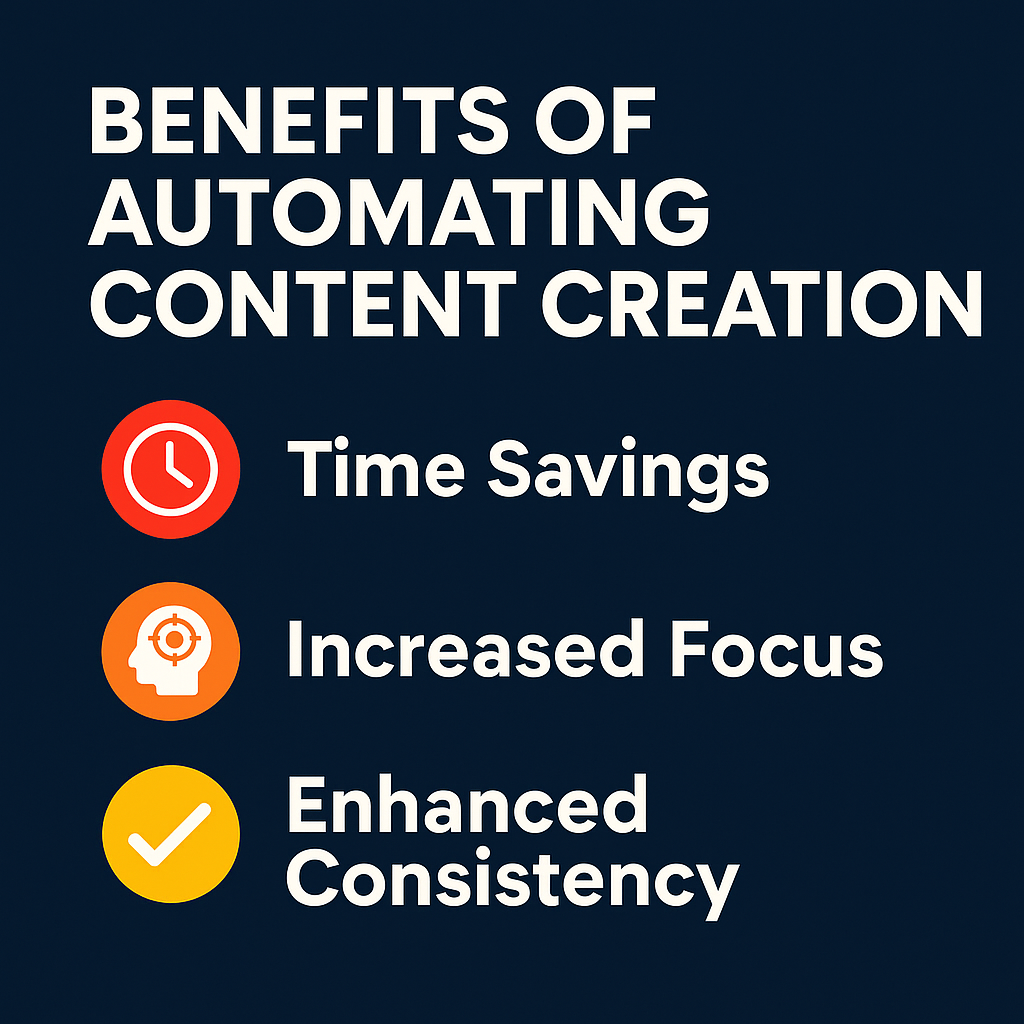
Once the system is running, the results compound fast:
- You get 5 to 10 hours back per week: In reality, hours that were going to ideation and writing now go to client work, sales, or strategy.
- Your content actually stays consistent: No more 3-week gaps between posts. On the contrary, the system runs whether you feel creative or not. As a result, your audience sees you regularly.
- Quality goes up, not down: Because the content comes from real conversations with real customers, naturally, it resonates more than anything you would brainstorm at your desk.
- Your reach grows without extra work: 1 meeting becomes 5 to 8 content pieces. Essentially, your distribution multiplies while your input stays the same.
That last point circles back to the StoryBrand idea. When your content system is built around the customer’s story rather than your brand’s story, every piece of content feels relevant to the reader. They share it. They save it. They come back for more. In short, the automation did not just save you time. It also made the content better.
How to Start Without Overcomplicating It
Do not try to build this whole system in a weekend. That is how automation projects die. Above all, pick 1 step. Start there.
My recommendation: start with step 1. Record your next 3 client calls. Afterwards, look at the transcripts and ask yourself: “What did my customer say that other customers would find valuable?” Surprisingly, that single question will give you more content ideas than a month of brainstorming.
Once you see how much raw material you are already sitting on, the rest of the system essentially builds itself. In fact, the hardest part is not the technology. It is the mindset shift from “I need to create content” to “I need to capture what already exists.”
The Bottom Line
Content does not have to be the thing that eats your week. In fact, the conversations you are already having contain everything your audience needs to hear. So build a system that captures those conversations, extracts the customer’s story, and distributes it across channels.
You stop being the bottleneck. Additionally, your content gets more authentic. And you get your time back for the work that actually grows the business.
That is what an AI Operating System does at its core. Specifically, it decouples your output from your personal hours. Content is just 1 piece of it.
How long does it take to set up a content automation system?
Most business owners can get the basics running in under a week. Start by recording your calls and using AI transcription. That alone gives you raw material. From there, add the content extraction and distribution steps 1 at a time. You do not need to build the whole thing at once.
Will automated content sound robotic or generic?
Not if you build it right. The secret is that the source material comes from real conversations, not from AI prompts about generic topics. When you pull insights from actual client calls, the content carries your voice and your specific expertise. Automation handles the formatting and distribution. The substance still comes from you. Think of it like a recording studio. The studio does not write the song. But it makes sure people hear it.
What tools do I need to automate content creation?
At minimum: a video call platform with recording (Zoom, Google Meet), an AI transcription tool (Otter.ai, Zoom’s built-in transcription), and an AI writing assistant for drafting. That covers 80% of the system. As you grow, you can add scheduling tools, multi-channel distribution, and workflow automation. But do not buy 5 tools on day 1. Start with what you have and add as you hit real bottlenecks.
Ready to see where AI can eliminate your biggest operational bottleneck? Take a free Hiring Tax Diagnostic and we will map exactly where you are bleeding time and money. Then explore how an AI Operating System can decouple your revenue from headcount permanently.