
Every new hire comes with a hidden cost that never shows up on your P&L.
The Growth Trap Nobody Talks About
There’s a dangerous assumption baked into most growth strategies: when you need to grow, you hire. More work means more people, right?
Wrong.
What looks like a straightforward solution is actually one of the most expensive mistakes growing businesses make. I call it the Hiring Tax. And it’s silently eating margins at companies between $5M and $50M in revenue.
Mike Michalowicz nailed this problem in Profit First: most businesses confuse revenue growth with profitability. They see more revenue coming in, so they spend more. The biggest line item? Headcount. And every new head doesn’t just cost a salary. It costs something far harder to see.
Key Takeaways
- The Hiring Tax is the invisible coordination overhead that grows every time you add a person. It typically eats 10-15% of revenue.
- Revenue growth does not equal profit growth. Adding headcount often shrinks margins faster than it grows the top line.
- Before approving any new hire, ask: “What system could handle this instead?”
- Companies that build systems instead of adding heads grow revenue without proportionally growing costs.
What Is the Hiring Tax, and Why Should You Care?
The Hiring Tax isn’t about salaries, benefits, or recruiting fees. Those are visible. The Hiring Tax is the invisible overhead that piles up every time you add a person to your org:
- Coordination costs increase exponentially, not linearly
- Communication overhead multiplies with each new team member
- Decision-making slows as more people need alignment
- Institutional knowledge gets diluted across more heads
- Management layers emerge to handle the complexity you just created
Here’s the brutal math: every new hire doesn’t just add their salary to your costs. They add friction to every process they touch.
Michalowicz’s core argument applies perfectly here. In Profit First, he shows that the natural instinct when revenue grows is to spend it, especially on people. But profit doesn’t come from revenue. It comes from what’s left after the Hiring Tax takes its cut.
4 Ways the Hiring Tax Shows Up in Your Business
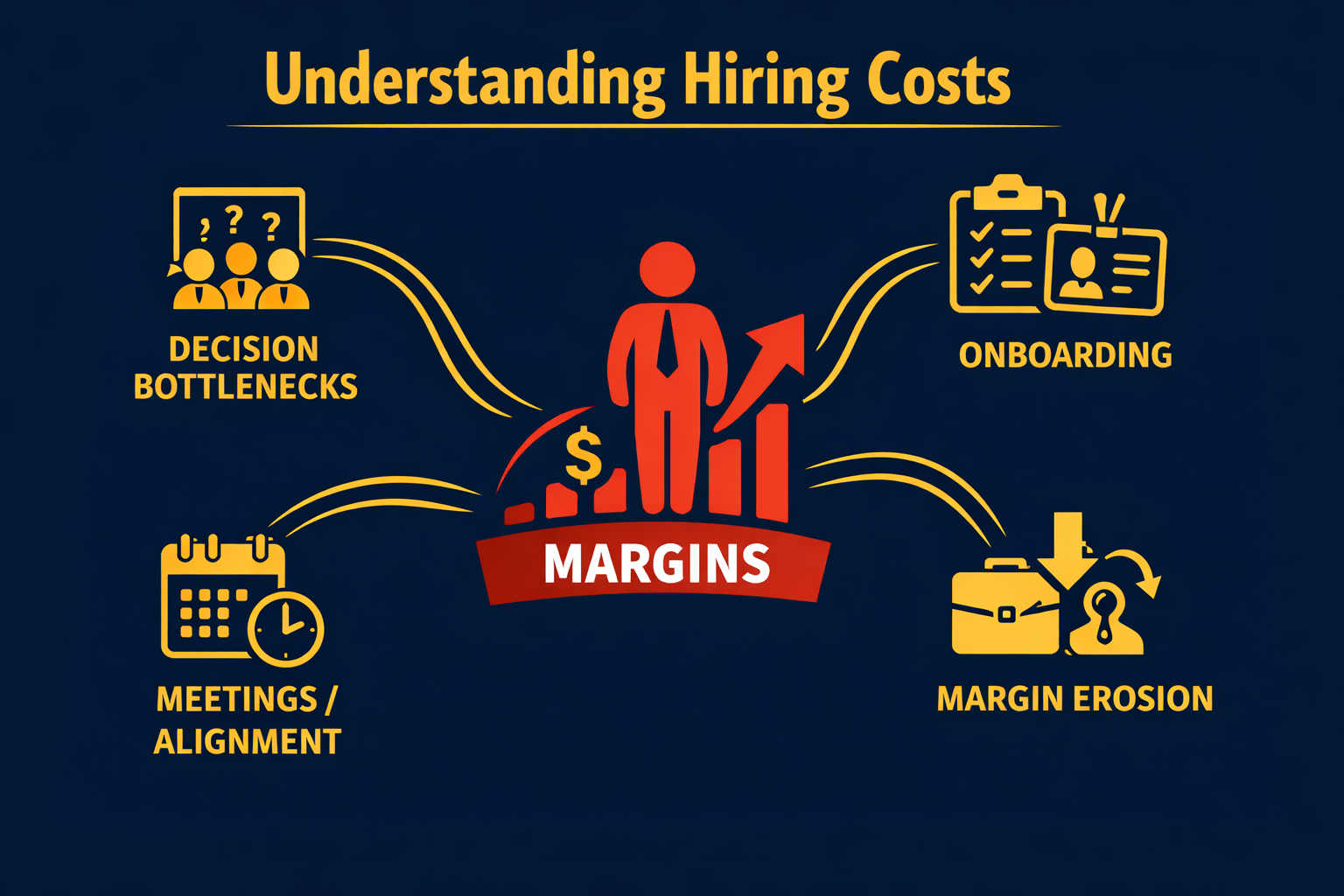
1. Meetings That Breed More Meetings
Watch what happens when you grow from 10 to 30 people. You need meetings to prepare for meetings. Sync sessions multiply. What used to be a quick Slack message now requires a 30-minute call with 5 stakeholders.
This isn’t dysfunction. It’s physics. According to research published in Harvard Business Review, the time employees spend on collaborative activities has increased by over 50% in the last 2 decades. More nodes in a network require exponentially more connections to stay coherent.
2. Bottlenecks at Every Decision Point
“Who owns this decision?” becomes the most common question in your company. Work stalls waiting for approval from someone who’s triple-booked. Projects that took days now take weeks because they’re stuck in someone’s review queue.
3. Manual Processes That Should Have Been Automated Months Ago
Here’s a pattern I see constantly: a company hires someone to handle a growing workload instead of building a system to manage it. 6 months later, they hire another person to help the first person. The work keeps growing, so they hire a third.
Meanwhile, a $500/month software solution could have handled the entire workflow automatically.
4. Margin Erosion Nobody Can Explain
Revenue grows 40%. Headcount grows 60%. Profit stays flat or shrinks. Leadership scratches their heads wondering where the money went.
It went to the Hiring Tax. A McKinsey analysis found that organizational complexity costs mid-market companies between 10-15% of revenue in hidden coordination overhead. That’s not a rounding error. That’s your profit.
Where Does 10-15% of Your Revenue Go?
In my experience working with growing businesses, the Hiring Tax typically eats 10-15% of revenue. It’s invisible because it’s spread across:
- Salaries for coordination roles that shouldn’t exist
- Lost productivity from alignment overhead
- Opportunity costs from slow decision-making
- Redundant work from poor communication
This tax never shows up as a line item. It’s buried in your org chart. And as the SBA notes, the true cost of an employee runs 1.25 to 1.4x their salary before you even account for coordination drag.
Why Hiring Is Not the Same as Growing
Here’s the contrarian truth that changed how I think about growth:
Hiring is dependency. Systems are growth.
When you hire, you’re adding a dependency. Someone who needs management, training, tools, and coordination. When you build a system, you’re adding capacity that works 24/7 without meetings, without PTO, without performance reviews.
This doesn’t mean never hire. It means stop defaulting to hiring as solution #1.
How to Cut Your Hiring Tax in 4 Steps

Step 1: Audit Every Task That Requires Human Coordination
Map out where work gets stuck waiting for people. Look for:
- Approval workflows
- Information handoffs
- Status update meetings
- Cross-team dependencies
These are your Hiring Tax hotspots.
Step 2: Identify What Software Can Handle
For each coordination point, ask: “Could software do this?” The answer is “yes” more often than most leaders think.
Modern automation tools can handle:
- Data entry and transfer between systems
- Approval routing with smart escalation
- Status reporting and dashboards
- Customer communication workflows
- Document generation and processing
Step 3: Build Systems Around What Must Stay Manual
Some work genuinely requires human judgment. For those tasks, build systems that cut coordination overhead:
- Clear ownership with documented decision rights
- Asynchronous communication defaults
- Self-serve information access
- Templated processes with checklists
Step 4: Make “System First” Your Default
Before approving any new headcount, require answers to:
- What system could handle this instead?
- What’s the coordination cost of this role?
- How does this affect decision-making speed?
- What’s the true fully-loaded cost including Hiring Tax?
This is the Profit First mentality applied to headcount. Pay your profit first. Then see if you still need that hire.
What Happens When You Fix This
Companies that internalize this framework experience something remarkable: they grow revenue without proportionally growing headcount. Margins improve instead of eroding. Teams move faster because there’s less coordination drag.
They’ve shifted from people dependency to systems that compound.
Where Is Your Hiring Tax Hiding?
Every business has Hiring Tax buried somewhere. The question is whether you’ll find it before it finds your margins.
Start with this exercise: list every recurring meeting on your calendar. For each one, ask: “What system failure does this meeting compensate for?”
The answers will show you exactly where your Hiring Tax is hiding.
Frequently Asked Questions
What is the Hiring Tax in business?
The Hiring Tax is the invisible overhead that accumulates every time you add a person to your organization. It includes exponentially increasing coordination costs, communication overhead, slower decision-making, diluted institutional knowledge, and new management layers. Unlike salaries and benefits, these costs never appear as a line item on your P&L, but they typically consume 10-15% of revenue.
How much does the Hiring Tax cost a typical mid-market business?
For companies between $5M and $50M in revenue, the Hiring Tax typically eats 10-15% of revenue. This cost is distributed across salaries for coordination roles that should not exist, lost productivity from alignment overhead, opportunity costs from slow decision-making, and redundant work caused by poor communication. It is invisible because it is buried in the org chart, not listed as a line item.
How can I reduce the Hiring Tax without cutting staff?
You can reduce the Hiring Tax by following a 4-step framework: (1) Audit every task that requires human coordination, identifying approval workflows, handoffs, and status meetings. (2) Identify what software and automation can handle instead of people. (3) Build systems around tasks that must stay manual, using clear ownership, async communication, and self-serve information. (4) Make ‘system first’ your default by requiring every new headcount request to answer what system could handle it instead.
Ready to find what’s quietly eating your margins? Take a free Hiring Tax Diagnostic to see exactly what adding headcount is costing you. Then see how an AI Operating System can decouple your revenue from headcount for good.